


A repeatable cannabis drying process is the first controlled manufacturing step after harvest and the foundation for clean, consistent trimming.
Best Manufacturing Practices for the Cannabis Industry · Softrim Starter Guide Series
Purpose of a Controlled Cannabis Drying Process
In cannabis manufacturing, the dry room is the first controlled process step after harvest, and it prepares flower for successful Softrim processing. The goal is not simply to make flower “dry.” It is to remove moisture in a controlled, reasonably uniform way so that unwanted leaf becomes dry and brittle while the flower retains internal moisture.
Like any manufacturing process, drying must be adjusted to its inputs: cultivar, plant preparation, starting hydration, drying duration, harvest size, room loading, airflow, and environmental-control capacity. Manufacturing only works when variables are limited to repeatable processes, and the Commercial Dry Room Schedule (Table 1) gives the dry room a repeatable starting point. The condition of the flower should ultimately determine how the process is adjusted.
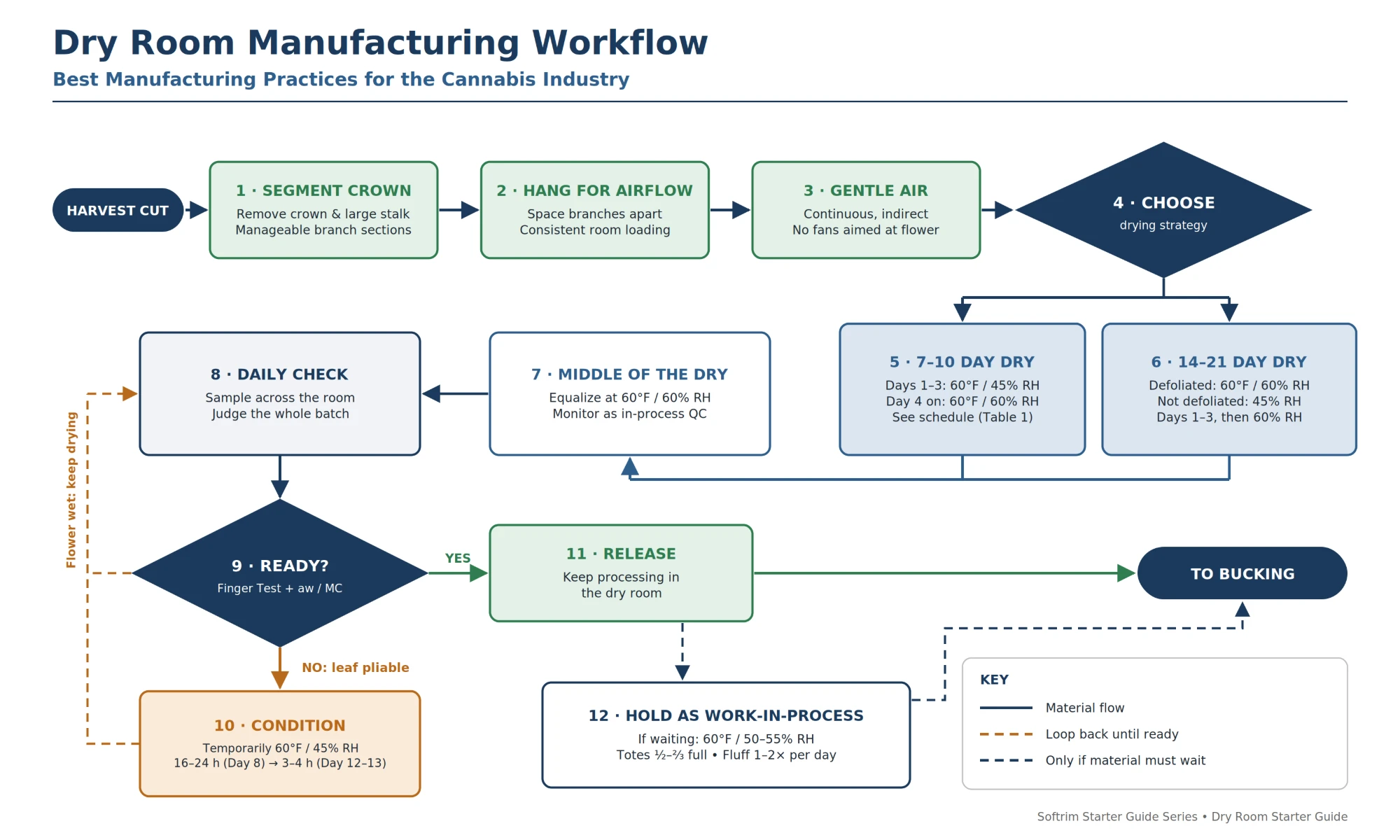
The diagram below shows the dry room workflow, and the rest of this guide walks through it step by step.
Quick Reference Guide
A road map of this guide, in the same order as the diagram. Review it before reading, then use it as a quick reference in the dry room. Click any topic to jump to that section.
| # | Topic | At a Glance |
|---|---|---|
| 1 | Segment the Crown | Remove the crown and large stalk; hang manageable branch sections. |
| 2 | Hang for Airflow | Space branches so air moves around them. Keep room loading consistent. |
| 3 | Gentle, Indirect Air | Continuous circulation. Never aim strong fans at flower. |
| 4 | Choose the Strategy | Plan around dry length and the moisture entering the room. |
| 5 | 7–10 Day Dry | Days 1–3 at 60°F / 45% RH, then 60°F / 60% RH. See Table 1. |
| 6 | 14–21 Day Dry | Defoliated: 60°F / 60% RH throughout. Not defoliated or very wet: 3-day 45% RH pull first. |
| 7 | Middle of the Dry | Equalize at 60°F / 60% RH and monitor like in-process QC. |
| 8 | Daily Check | Sample across the room; adjust for the whole batch, not one bud. |
| 9 | Ready? Finger Test & Moisture | Brittle leaf, resilient flower, aw 0.58–0.62, MC 10–14%. |
| 10 | Softrim Conditioning | Leaf still pliable: 60°F / 45% RH, 16–24 h on Day 8 down to 3–4 h by Days 12–13. |
| 11 | Release: Process in the Dry Room | Buck, stage, and trim in the same controlled environment. |
| 12 | Hold as Work-in-Process | 60°F / 50–55% RH, totes ½–⅔ full, fluff 1–2× per day. |
The dry room formula: dry, brittle leaf + resilient flower + consistent moisture = Softrim-ready material.
Walking Through the Workflow
Each step below follows the diagram from the harvest cut to bucking.
1. Segment the Crown Before Hanging
Best practice: Before hanging, segment branches away from the main crown or stalk whenever practical rather than drying the whole plant with the crown intact.
Why it matters: The crown and larger stalk hold substantial moisture and add unnecessary water load. Leaving them attached increases moisture variation: upper flower is ready before lower flower, smaller buds and larf stay wetter, leaf near the lower branch stays pliable, and parts of the same plant reach Softrim readiness at different times.
What good looks like: Main crown and excessively large stalk removed; plant separated into manageable branch sections still large enough to hang and handle.
Think manufacturing: consistent part size produces consistent results. The goal is not very small pieces, but removing unnecessary structural mass.
2. Hang Material for Airflow
Best practice: Hang branches with enough separation for air to move around the material; do not pack them tightly together.
Why it matters: Touching, overlapping, or compressed branches create localized areas where moisture leaves more slowly. Proper spacing reduces wet spots, evens out exposure across the room, and reduces variation between plants and sections.
The goal is uniform environmental exposure, not maximum room density. Consistent loading is the dry room equivalent of a balanced production line.
3. Use Gentle, Indirect Air Circulation
Best practice: Maintain continuous, gentle circulation throughout the room. Do not point strong fans directly at hanging flower.
Why it matters: Circulation removes stagnant pockets of humid air and microclimates, creating more uniform drying and leaf conditioning. Excessive direct airflow, however, dries exposed surfaces faster than the inside of the flower and branch, which contributes to case hardening: a dry exterior with moisture trapped inside. Air should move through the room without blowing individual branches around.
4. Choose the Drying Strategy
Just as a manufacturer sets a production schedule around its inputs, the drying strategy should account for both how long you intend to dry the flower and how much moisture and plant material are entering the room. Both approaches below can produce Softrim-ready flower.
5. 7–10 Day Dry: The Commercial Dry Room Schedule
Phase 1, initial moisture pull (Days 1–3): 60°F / 45% RH. Freshly harvested plants bring their greatest moisture load at the start. The lower RH keeps dehumidification actively removing water, and expected bud moisture content falls from roughly 75–80% on Day 1 to 45–50% by Day 3.
Why it matters: A 7–10 day dry has less total time for moisture removal and equalization. Pulling moisture early manages the initial load, starts equalization sooner, reduces moisture held in the wettest parts of the plant, leaves more time later for differences to stabilize, and avoids aggressive corrections near the end. The objective is not to dry the crop as quickly as possible, but to make the rest of the cycle predictable and repeatable.
Phase 2, equalization and stabilization (Day 4 on): Raise the room to 60°F / 60% RH. Bud moisture content keeps falling and reaches the Softrim target range of 10–14% at about Days 9–10.
Table 1. Commercial Dry Room Schedule for Manufacturing Cannabis (Full Overview)
| 7–10 Day Dry Room Schedule | Softrim Conditioning | ||||||
|---|---|---|---|---|---|---|---|
| Day | RH Setpoint | Temp. | Expected Bud MC% | Expected aw | RH Setpoint (Duration) | Expected MC% | Expected aw |
| Day 1 | 45% | 60°F | 75–80% | — | — | — | — |
| Day 2 | 45% | 60°F | 60–65% | — | — | — | — |
| Day 3 | 45% | 60°F | 45–50% | 0.60–0.62 | — | — | — |
| Day 4 | 60% | 60°F | 30–35% | 0.58–0.62 | — | — | — |
| Day 5 | 60% | 60°F | 27.5–32.5% | 0.58–0.62 | — | — | — |
| Day 6 | 60% | 60°F | 22.5–27.5% | 0.58–0.62 | — | — | — |
| Day 7 | 60% | 60°F | 17.5–22.5% | 0.58–0.62 | — | — | — |
| Day 8 | 60% | 60°F | 12.5–17.5% | 0.58–0.62 | 45% (12–24 hrs) | 10–14% | 0.58–0.62 |
| Day 9 | 60% | 60°F | 10–14% | 0.58–0.62 | 45% (8–12 hrs) | 10–12% | 0.58–0.62 |
| Day 10 | 60% | 60°F | 10–14% | 0.58–0.62 | 45% (4–8 hrs) | 10–12% | 0.58–0.62 |
| Day 11 | 60% | 60°F | 9–13% | 0.55–0.62 | 45% (4–6 hrs) | 9–11% | 0.55–0.60 |
| Day 12 | 60% | 60°F | 8–12% | 0.55–0.60 | 45% (3–4 hrs) | 9–11% | 0.55–0.60 |
| Day 13 | 60% | 60°F | 8–12% | 0.55–0.60 | 45% (1–2 hrs) | 9–11% | 0.55–0.60 |
| Day 14 | 60% | 60°F | 8–12% | 0.55–0.60 | 45% (1–2 hrs) | 9–11% | 0.55–0.60 |
| 14–21 Day Dry Room Schedule | |||||||
| With 21-day defoliation | Hold 60% RH / 60°F for the full 14 to 21 day dry | ||||||
| Without defoliation | First 3 days 45% RH / 60°F, then 60% RH / 60°F for the remainder of the dry | ||||||
Two-phase dry schedule: aggressive initial pull (Days 1–3), then equalization & stabilization (Days 3–14). Softrim Conditioning (right-hand columns) is the finishing step described in Section 10: the duration at 45% RH depends on the day the batch is conditioned. Values are expected ranges for process planning and monitoring; confirm each batch with the checks in Sections 8–9.
6. 14–21 Day Extended Dry
With a longer cycle, a strong initial pull is not always necessary. The schedule depends primarily on whether the plants were defoliated (bottom of Table 1):
- With 21-day defoliation: hold 60% RH / 60°F for the full 14 to 21 day dry.
- Without defoliation: 45% RH / 60°F for the first 3 days, then 60% RH / 60°F for the remainder of the dry.
The extra time lets moisture leave gradually and redistribute between flower, leaves, stems, and branches. Even so, a 3-day pull at 60°F / 45% RH may help when material enters with heavy foliage, high starting hydration, large retained branches, excess crown or stalk, or high room loading, shortening the time wet material spends in the earliest, highest-risk stage.
Key principle: a longer dry provides more time for equalization, but it does not eliminate the need to manage excessive starting moisture.
7. Managing the Middle of the Dry
After the initial removal period, the process shifts to controlled drying and moisture equalization at approximately 60°F / 60% RH. Treat this stage like in-process quality control, comparing upper versus lower flower, large versus small buds, flower near larger branches, sugar-leaf condition, flower firmness, and differences between cultivars and areas of the room. Moisture differences should shrink as the batch moves toward Softrim readiness.
8. Check the Dry Room Daily
Treat the daily check as an in-process inspection; never judge a harvest from one flower or one spot. Inspect flower from multiple areas of the room, different plants, the upper, middle, and lower branch, and both large and small buds. Compare leaf brittleness, flower firmness, and moisture consistency. Base environmental adjustments on the overall condition of the harvest, not one isolated sample.
9. Ready? The Finger Test & Moisture Confirmation
The Finger Test is the simplest and most important readiness check: gently rub the unwanted leaf surrounding the flower.
Table 2. Finger Test Results
| Softrim-Ready | Not Ready |
|---|---|
| Leaf feels dry and brittle, cracks or breaks easily, and separates from the flower with minimal resistance.
Flower remains resilient, slightly spongy internally, and structurally intact. |
Leaf folds, bends, rolls, feels soft, or feels leathery or pliable.
Leaf pliable: condition (Section 10). Flower still wet: keep drying. |
Confirm moisture: Where testing equipment is available, use it as the quality-release check before material moves to Softrim. Recommended starting range: Water Activity 0.58–0.62 aw and Moisture Content 10–14%, with 10–12.5% MC commonly a strong starting condition. These are the targets reached in Table 1. Measurements should not be used alone: flower can be in range while the surrounding leaf is still too pliable to trim efficiently.
Release criteria: Dry, brittle unwanted leaf; resilient flower structure; reasonably uniform moisture with minimal upper-to-lower difference; no obvious wet pockets; a consistent Finger Test; and aw and MC in range where tested. Exact condition varies by cultivar.
Best practice: evaluate Water Activity + Moisture Content + Finger Test + physical flower condition before releasing a batch. Flower moisture alone does not determine Softrim readiness; the leaf Softrim needs to remove matters just as much.
10. Softrim Conditioning
If the flower is close to the desired condition but the leaf still needs conditioning, temporarily lower the room to 60°F / 45% RH, then recheck. As the Softrim Conditioning columns of Table 1 show, the later in the dry this step is applied, the shorter the window: 16–24 hours on Day 8, down to 3–4 hours by Days 12–13.
Table 3. Why the RH Changes During the Dry
| RH Change | Purpose |
|---|---|
| Initial reduction | Removes excess moisture from freshly harvested plant material. |
| Mid-dry | Allows controlled moisture removal and equalization. |
| Final reduction | Develops the dry, brittle leaf required for Softrim while preserving internal flower moisture. |
Base the finishing drop on flower condition, not the calendar. The objective is to crisp the leaf, not over-dry the flower.
11. Release: Keep Processing in the Dry Room
Once flower is Softrim-ready, avoid exposing it to warmer or more humid environments before trimming. When layout allows, keep the entire manufacturing cell in the controlled environment: buck, stage, store waiting material, and operate Softrim in the dry room. Conditioned leaf can regain moisture in higher humidity, and material that passed the Finger Test can become harder to trim if the leaf turns pliable again.
12. Hold as Work-in-Process
Flower that cannot be processed immediately is work-in-process inventory. The goal is to maintain its Softrim-ready condition without moisture accumulating or redistributing unevenly in the container. Hold at approximately 60°F / 50–55% RH, with 55% the upper end of the range, and:
- Fill totes 1/2 to 2/3 full maximum, never tightly packed or compressed, so material can be moved and redistributed.
- Do not use closed bags inside totes; they trap moisture and let conditioned leaf soften unevenly within the same tote.
- Tote lids may remain on where appropriate.
- Fluff and/or flip the material at least 1–2 times per day.
- Minimize exposure to warmer or more humid environments.
- Recheck the Finger Test before Softrim if material has been held for an extended period.
The objective is to maintain the condition developed during drying rather than recreate it immediately before processing.
Dry Room Checklist
| Do | Avoid |
|---|---|
|
|
Key Takeaway
Successful Softrim drying is about managing moisture, not reaching a specific number of drying days. A 7–10 day dry benefits from a stronger pull (60°F / 45% RH) in about the first 72 hours; a 14–21 day dry can often stay near 60°F / 60% RH, for defoliated plants the whole cycle; heavily hydrated material may need an initial pull either way; and either strategy may need a final 60°F / 45% RH conditioning step before Softrim.
Dry, brittle leaf + resilient flower + consistent moisture = Softrim-ready material.
Next Step: Bucking Starter Guide
Once flower reaches processing condition, the next manufacturing step is to remove the flower from the branch cleanly, minimize remaining stem, separate major flower categories, and stage the material correctly for Softrim.
Read the Bucking Starter Guide →