


This cannabis quality control process works like an assembly line, so pass-through flower stays untouched and QC labor goes only where it is needed.
Best Manufacturing Practices for the Cannabis Industry · Softrim Starter Guide Series
Purpose of Cannabis Quality Control
Quality Control (QC) needs to be considered for every cannabis trimming facility. However, each trimming process produces a different flower output. In this paper we discuss best-practice QC for the Softrim process.
When material is properly prepared, our field observations indicate Softrim customers achieve approximately 60–90% pass-through quality flower. This is flower that needs no additional human touch and can go directly into the finished bag.
As with any new process, every area of manufacturing needs to be reviewed. When we observed QC teams in the field using the traditional one-tote-per-QC-member approach, we saw over-trimming as old habits of scissor shaving came into play. Because the Softrim process retains so much pass-through product, we developed a QC process that reduces process steps, which in turn reduces labor and increases product quality.
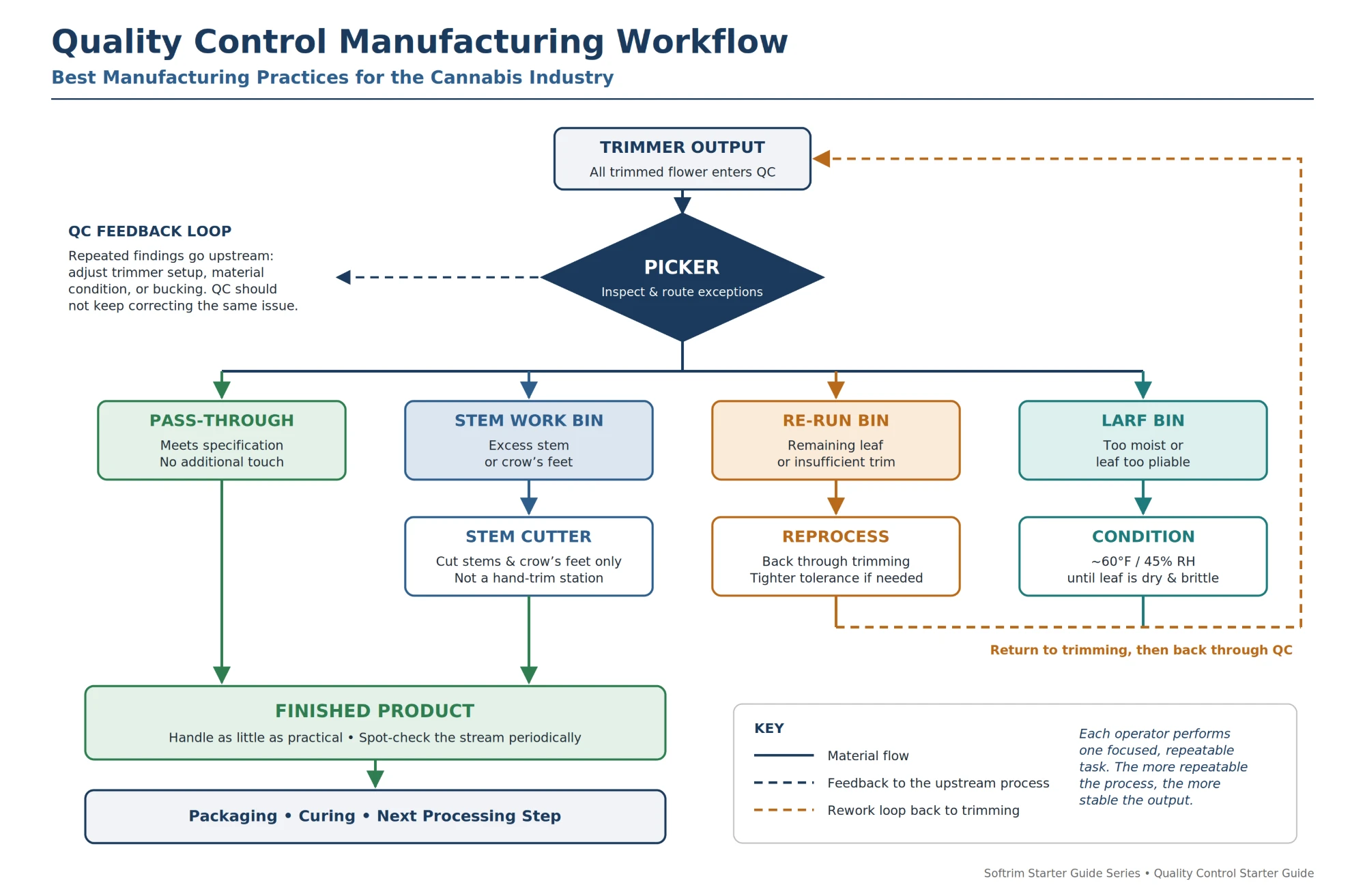
This process works more like an assembly line than a single-person workstation. The diagram below shows the process flow, and the rest of this guide walks through it step by step.
Quick Reference Guide
A road map of this guide, in the same order as the diagram. Review it before reading, then use it as a quick reference on the manufacturing floor. Click any topic to jump to that section.
| # | Topic | At a Glance |
|---|---|---|
| 1 | Trimmer Output | All Softrim output enters QC. Batch or cultivar ID stays with the material. |
| 2 | The Picker | Most qualified team member inspects every bud and routes it to one of four streams. The Picker does not trim. |
| 3 | Pass-Through | Meets spec, goes straight to Finished Product with no extra touch. Stem reference: 1/4 inch or less. |
| 4 | Stem Work & Stem Cutter | Cut stems and crow’s feet only. Not a hand-trim station. |
| 5 | Re-Run & Reprocess | Leafy flower goes back through Softrim, with a tighter tolerance if needed. |
| 6 | Larf & Conditioning | Condition at ~60°F / 45% RH until the leaf is brittle, then Softrim, then QC. |
| 7 | The Rework Loop | All reprocessed flower goes back through the Picker. Nothing skips inspection. |
| 8 | Finished Product | Handle minimally, spot-check the stream, move to packaging, curing, or the next step. |
| 9 | The QC Feedback Loop | Repeated findings get fixed upstream, not corrected forever in QC. |
| 10 | Why the Assembly Line Works | One focused, repeatable task per operator; no labor bottleneck. |
| 11 | Keep Streams Separate | Dedicated, labeled containers. Streams never mix. |
The QC formula: Picker finds the exceptions → Stem Cutter fixes stems → Softrim removes remaining leaf → conditioning prepares larf → finished flower keeps moving.
Walking Through the Workflow
Each step below follows the diagram from top to bottom.
1. Trimmer Output
All flower leaving Softrim enters QC, either in totes at a QC station or on a conveyor line. Where the facility requires it, batch or cultivar identification stays with the material from this point through QC and any reprocessing, a basic manufacturing traceability practice.
2. The Picker
The Picker is your most qualified QC team member (or members). The Picker physically picks up every bud, inspects it, and places it into one of four streams. The Picker does not trim; the job is to identify exceptions quickly and keep finished flower moving.
Because most flower already meets specification, a tote full of finished flower creates visual pollution for anyone searching for the few buds that need attention. A dedicated inspection role keeps that search focused.
Table 1. The Four QC Streams
| Stream | What Goes In It | Next Step |
|---|---|---|
| Pass-Through | Meets the site’s specification | Finished Product |
| Stem Work Bin | Excess exposed stem or crow’s feet | Stem Cutter, then Finished Product |
| Re-Run Bin | Remaining leaf, insufficient deleafing, material much different in size from the batch, or material processed without adequate pre-sorting | Reprocess through Softrim, then back through QC |
| Larf Bin | Larf too moist, or with leaf too pliable, to trim effectively | Condition at ~60°F / 45% RH, then Softrim, then QC |
Key principle: The Picker identifies what needs work. The Picker does not do the work.
3. Pass-Through
Pass-through flower meets the site’s trim specification, needs no additional leaf removal, keeps its natural size and structure, and has acceptable stem presentation. It goes straight to Finished Product.
Stem presentation: In many commercial operations, 1/4 inch or less of exposed stem is an acceptable starting reference. Final presentation varies with cultivator preference, product grade, packaging format, and consumer expectations, so treat it as a starting point, not a universal requirement.
Pass-through flower stays pass-through. Do not re-handle buds that already meet specification.
4. Stem Work Bin → Stem Cutter
The Stem Cutter receives only flower from the Stem Work bin and performs one repeatable task: scissor-cut excess stem and remove crow’s feet while preserving the flower’s natural size and structure, then move it to Finished Product.
The Stem Cutter is not a hand-trim station. Flower that needs significant leaf removal belongs in the Re-Run bin.
Key principle: Picker identifies the issue. Stem Cutter performs the correction.
5. Re-Run Bin → Reprocess
Leafy flower goes back through Softrim rather than being hand-trimmed, using settings suited to the remaining leaf, flower size, and material condition. This may include a tighter tolerance than the first pass.
Flower can be re-run as many times as necessary to reach specification while maintaining minimal to no damage to trichomes or bud characteristics. Let the finished trim requirement and the flower’s response set the number of passes, not a fixed limit.
Key principle: Leaf removal belongs in Softrim whenever practical. QC identifies what needs to go back.
6. Larf Bin → Condition
Larf typically has a higher leaf-to-flower ratio and may hold moisture differently from larger flower, so it often needs more drying before another pass. If larf is too moist or its leaf too pliable:
- Separate it into its own container and move it to the dry room or another controlled area.
- Condition at approximately 60°F / 45% RH, checking periodically rather than relying on a fixed time.
- Stop when the unwanted leaf is dry and brittle and the flower is still intact.
- Re-run it through Softrim and return it through QC.
Why 60°F / 45% RH? At about 60°F / 60% RH, larf takes longer to reach the leaf brittleness needed for reprocessing. The lower humidity provides a stronger moisture pull. The goal is to condition the leaf, not to overdry the larf.
7. The Rework Loop
Everything reprocessed, both Re-Run flower and conditioned larf, returns to the top of the diagram as trimmer output and goes back through the Picker. Nothing skips inspection, so every bud is held to the same manufacturing standard no matter how many passes it took.
8. Finished Product
Finished product combines pass-through flower and Stem Cutter output. Two practices protect it:
- Handle it as little as practical. Extra handling increases bud surface contact and breakdown, slows QC, and adds operator variability. Every extra touch is an uncontrolled variable in the manufacturing process.
- Spot-check the stream periodically. Flower condition can shift during a batch, especially when changing flower sizes, plant sections, containers, cultivars, or moisture conditions. Spot-checks catch drift without hand-inspecting every bud.
Once QC confirms flower meets specification, move it to the facility’s preferred environment for packaging, curing, or the next processing step, following its own curing practices, packaging procedures, product specifications, storage requirements, and SOPs. Further grading or sorting (by size, grade, packaging format, or customer specification) is done only when the facility’s specifications require it.
9. The QC Feedback Loop
When the Picker sees the same issue repeatedly in a batch, fix it upstream instead of letting QC keep correcting it.
Table 2. Reading Repeated QC Findings
| Repeated Finding | Upstream Response |
|---|---|
| 1–2 leaves repeatedly remaining | A minor Softrim spacing adjustment may be appropriate. |
| More significant leaf remaining | Softrim setup, material condition, or reprocessing approach may need adjustment. |
| Breakup appearing | The current Softrim setup may be too aggressive for the flower. |
| Excessive stem work | Evaluate bucking technique or stem-cut length before Softrim. |
Supporting Practices
10. Why the Assembly Line Works
Softrim processes flower faster than traditional hand finishing can trim each piece. In the one-tote-per-person model, every operator inspects, stem-cuts, hand-trims, sorts, and finishes every bud, which creates a labor bottleneck and invites over-trimming. The assembly line assigns each correction to the step best suited for it, so each operator performs one focused, repeatable manufacturing task.
11. Keep Material Streams Separate
Keep Finished Product, Stem Work, Re-Run, and larf awaiting conditioning in clearly separate, labeled containers. This prevents finished flower from being reprocessed, Re-Run material from reaching finished product, wet larf from mixing with processable flower, and operators from sorting the same material twice.
QC Checklist
| Do | Avoid |
|---|---|
|
|
Key Takeaway
QC after Softrim works best as an assembly line built around removing exceptions, not reworking the whole product stream. With approximately 60–90% pass-through, most flower needs no further touch, and QC labor goes only where it is needed.
Every operator performs one focused, repeatable task. The more repeatable the process, the more stable the output.
Related Guides
QC findings feed straight back into trimming. Tune your setup with the Softrim 1000 Trimming Starter Guide, and condition larf using the Dry Room Starter Guide.