

If you’ve ever stood in your dry room, squeezed a bud, and thought “that’s probably good enough” — you’re in good company. Every grower, from the biggest commercial barn to a closet with a couple of tents, hits that moment where patience runs thin.
The good news is you don’t need a lab, or a fancy meter, to dry safely. You just need to understand what’s happening inside that bud, and be willing to give it the time it actually needs. This guide walks through why rushing a dry can backfire in ways you can’t see from the outside — and why, if you don’t have testing equipment on hand, simply taking it slow (12 to 14 days, or longer if your room runs cool or humid) is a genuinely safe and reliable way to get there.
Short answer
- The outside of a bud can feel bone-dry days before the inside has caught up — surface feel alone is where most early pulls happen.
- Mold, mildew and bacteria all need available moisture to grow. Pulling early leaves them exactly what they need, which is why a jar that looked dry can turn moldy weeks later.
- There is a sweet spot: too wet invites mold and a harsh, green taste; too dry burns off terpenes. A slow dry lands you comfortably inside that window without special equipment.
- No meter? Plan on a full 12–14 day dry, longer if your room stays humid or your buds are dense.
- When you’re unsure, err long. A few extra days costs very little; an early pull is the mistake that actually leads to mold.
The chart that explains it all
This chart looks technical at first glance, but the idea behind it is simple: it shows how different kinds of trouble — mold, harsh flavor, and lost aroma — each become more or less likely depending on how much moisture is still available inside your bud. You don’t need to measure that number yourself to dry safely. The chart is here to explain why time and patience work, not to suggest you need to go buy equipment.
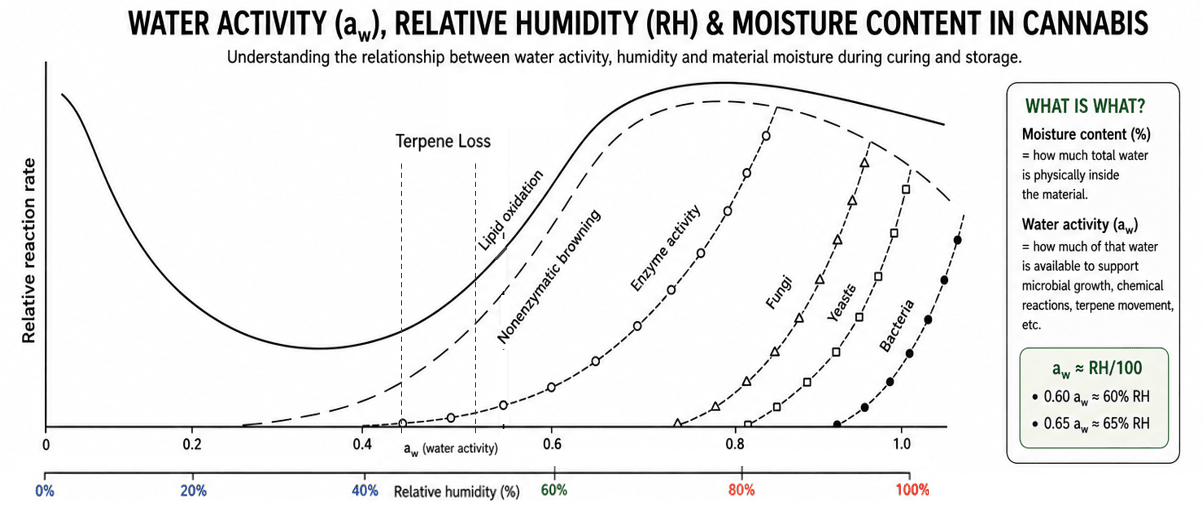
Water activity, relative humidity and moisture content in cannabis — the relationship between available moisture, spoilage risk and terpene retention during curing and storage.
| Moisture content (%) | How much total water is physically inside the material. |
|---|---|
| Water activity (aw) | How much of that water is available to support microbial growth, chemical reactions, terpene movement, and so on. |
| aw ≈ RH / 100 | Water activity tracks relative humidity: 0.60 aw ≈ 60% RH, 0.65 aw ≈ 65% RH. |
The shape of this curve is well established in food science, and it applies directly to dried, cured cannabis: there’s a genuine sweet spot in the middle, with different risks waiting on either side of it. This chart represents estimates, not actuals.
Frequently asked questions
What does “pulling my crop early” actually mean?
It’s not about harvesting the plant too soon — it’s about taking your buds out of the dry room, or calling the cure done, before they’ve actually reached the right moisture level inside. This usually happens because the outside of the bud feels dry, or because you’re just ready to be done. But here’s the thing: the outside of a bud can feel bone-dry days before the inside has caught up. Trusting the surface alone is where most early pulls happen.
Why does water activity matter more than just counting days?
Because your bud doesn’t know what day it is — it only responds to how much moisture it’s still holding onto. Two buds that both dried for exactly six days can be in very different shape depending on your room, your strain, and your airflow. You don’t need to measure this number to dry safely; it’s just worth understanding, because it’s the reason “give it more time” is genuinely good, science-backed advice rather than just an old grower’s saying.
What actually happens if I pull my buds too soon?
You’re taking them out right in the riskiest part of the process. When there’s still a good amount of moisture available inside, that’s exactly when mold, mildew, and unwanted bacteria have the easiest time getting a foothold — and it’s also when the plant’s own enzymes are still active, which can leave you with a harsher, more “green” taste instead of a smooth one. Pulling early doesn’t lock in freshness the way it might feel like it does. It mostly just locks in risk.
Why is mold risk highest right when people are tempted to pull early?
Mold, mildew, and bacteria all need a certain amount of available moisture to survive — think of it like they each have a minimum amount of water they need to “drink” to keep growing. Bacteria need the most, yeast and mildew need a bit less, and mold can get by on the least of the three. All of them need more moisture than your finished, properly cured bud will have. So if you pull early, while that moisture is still available, you’re handing all three of them exactly what they need — which is why a jar that looked perfectly dry going into storage can still turn moldy a few weeks later.
What is the “Terpene Loss” line on the chart about?
That line marks the point where going too dry starts working against you too. Once your bud drops below that line, the aromatic oils responsible for smell and flavor — the terpenes — start breaking down faster. So there really is a sweet spot: too wet and you’re inviting mold and harsh flavor; too dry and you’re cooking off the smell and taste you worked all season to grow. In practice, that window is wide enough that a slow, patient dry will land you comfortably inside it without any special effort.
Can I actually dry cannabis too much, not just too little?
Technically yes, but it’s a much smaller worry than pulling too early, and it takes real overkill to get there — think weeks longer than needed in a hot, bone-dry room. For almost every home and barn setup, the far more common mistake is rushing, not overdoing it. If you’re ever choosing between a bit too long and a bit too short, err long: a few extra days of patience is a much safer bet than an early pull.
Do I need a water activity meter or lab equipment to dry safely at home?
No. Plenty of great flower has been dried and cured with nothing more than a thermometer, a hygrometer, and patience. If you don’t have testing equipment, the simplest safe approach is to give it time: plan on a full 12–14 day dry, and let it run longer still if your room tends to stay humid, your buds are dense, or leaves just don’t feel brittle yet. There’s very little downside to going slow, and it’s the single most reliable substitute for precise measurement. Equipment like a water activity meter can add confidence and help you fine-tune, but it’s a nice-to-have, not a requirement for a good-quality dry.
How do I know when my crop is dry and ready to trim?
Trust your hands, and don’t be afraid to give it extra time. The classic finger test still works well: run a finger down the side of a bud, and if the small leaves snap off clean instead of bending, you’re in good shape. You can also use the stem test — bend a stem, and if it breaks rather than folds, that’s another good sign it’s ready. If you’re at all unsure, waiting a few more days costs you very little, but pulling too soon is the mistake that actually leads to mold. When in doubt, let it dry longer.
About this guide
This guide is offered as a companion to the Softrim Recommended Dry Procedure, in the same spirit of sharing practical, field-tested knowledge with growers of every size — from full commercial barns down to a single tent in a spare room. It reflects general drying and curing principles; your own timing will vary depending on your strain, your room, and the size of your harvest, and that’s completely normal. As with all growing advice, results will vary a little depending on your setup — and that’s part of the fun of learning your own room.