
As the cannabis industry matures, growers and processors are increasingly documenting not just what works, but why it works — building a shared, evidence-based understanding of the plant that benefits the entire supply chain. Larf is one area where field experience and plant physiology meet directly. Nearly every cultivator encounters it, yet it is rarely discussed with the same rigor applied to primary flower.
This reference looks closely at what larf is, why it forms, and why treating it as its own category — rather than an afterthought — can meaningfully improve consistency from harvest through finished product. For operations pursuing manufacturing-grade repeatability, larf is worth understanding as a signal as much as a byproduct.
Short answer
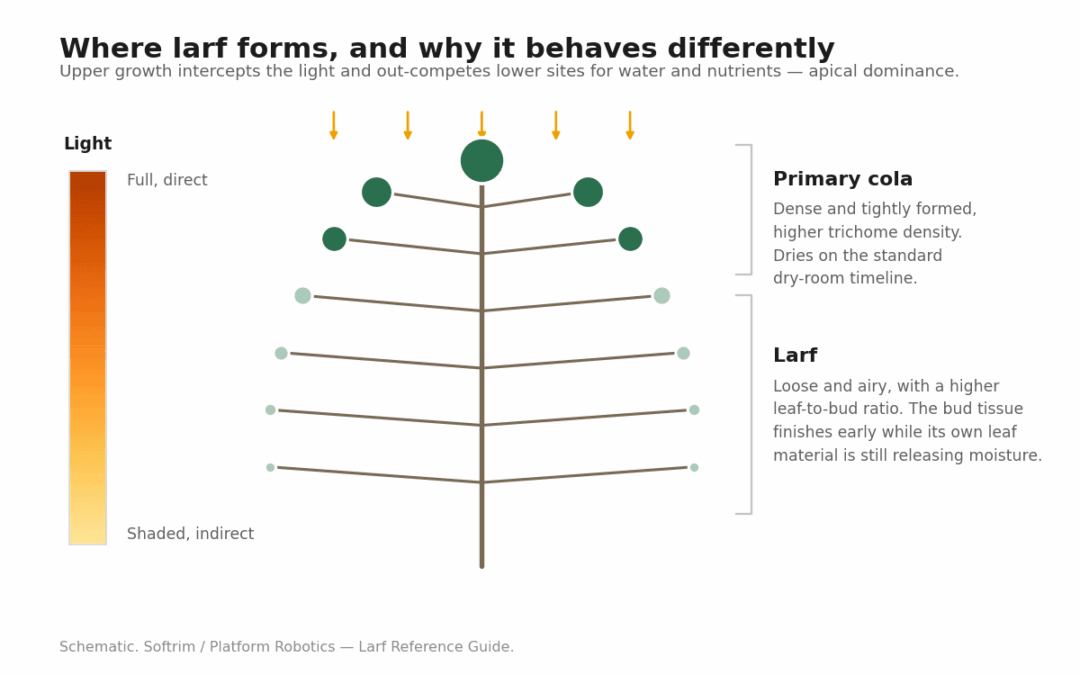
- Larf is the loose, airy growth on a plant’s lower and interior branches, shaded from the main light source. It’s a normal outcome of how the plant allocates resources — not a sign of disease or damage.
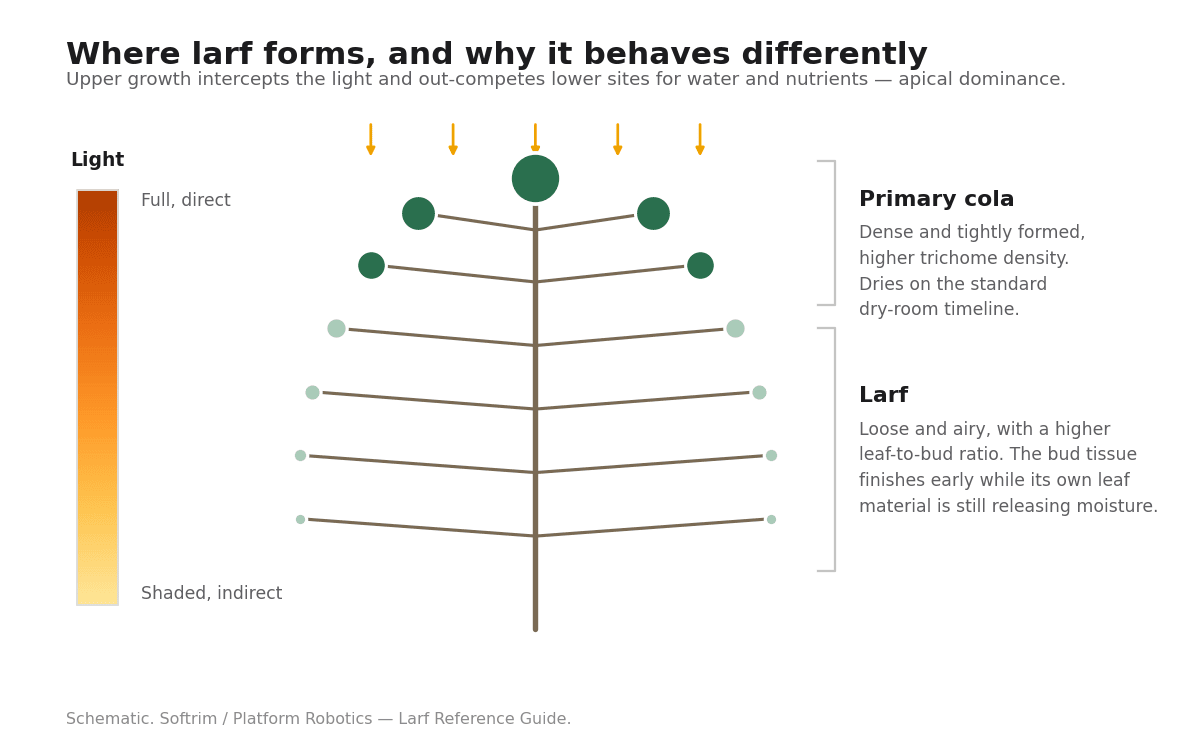
- It forms through apical dominance: upper growth intercepts the light and out-competes lower sites for water and nutrients.
- Most commercial growers remove it during the grow — lollipopping or lower-canopy defoliation — to redirect resources upward and open up airflow.
- It dries on its own schedule. The bud tissue can reach target water activity early while its higher proportion of leaf material is still releasing moisture.
- More larf than expected is often a room signal: uneven light distribution, poor airflow, an overcrowded canopy, or inconsistent training.
Larf vs. primary cola: a comparative reference
The table below summarizes the structural and physiological differences between larf and primary cola growth, and how those differences carry through into drying and processing.
| Attribute | Larf (lower-canopy growth) | Primary cola (upper-canopy growth) |
|---|---|---|
| Position on plant | Lower and interior branches, shaded from the main light source | Upper canopy, direct light exposure |
| Light exposure | Reduced / indirect | Full / direct |
| Bud structure | Loose, airy, less developed calyx formation | Dense, tightly formed |
| Trichome coverage | Lower relative density | Higher relative density |
| Nutrient & water uptake | Often disproportionate to development — draws resources without fully using them | Proportional to growth and light input |
| Relative moisture at harvest | Frequently higher relative to bud mass | Standard baseline for the cultivar |
| Surrounding leaf material | Higher leaf-to-bud ratio; leaf tissue holds moisture longer than the bud itself | Lower leaf-to-bud ratio; more evenly exposed bud surface |
| Drying behavior | Bud tissue can reach target water activity quickly, but the surrounding leaf material often lags — producing an uneven, harder-to-predict overall dry time | Follows the standard dry-room timeline |
| Common downstream use | Pre-rolls, extraction (rosin / solvent), infusions | Premium flower, retail-ready bud |
Differences in density and leaf-to-bud moisture retention are the primary reasons larf is often best managed on its own timeline rather than alongside primary flower.
Frequently asked questions
What is larf, botanically speaking?
Larf refers to the smaller, less dense flower clusters that develop on the lower and interior branches of a cannabis plant, at growth sites farther from the plant’s primary light source. Structurally, this reduced development is driven by lower photosynthetic input at those sites and the plant’s natural prioritization of resources toward the growth points receiving the most light — a phenomenon related to apical dominance, in which the uppermost growth suppresses and out-competes lower branches for light, water, and nutrients.
Why does larf form on nearly every plant?
Canopy shading is the primary driver: as upper growth fills in, lower and interior sites receive progressively less direct light, which limits their photosynthetic capacity and bud development. Genetics and training also play a role — taller, more sativa-leaning cultivars with less lateral branching tend to produce more larf, while shorter, more evenly lit plants (and canopy management techniques such as topping, defoliation, or screen training) tend to produce less. Environmental stress, including heat stress or an extended flowering stretch, can compound the effect.
Why do commercial growers remove larf during cultivation?
Because larf continues to draw water and nutrients that could otherwise support development at the primary cola sites, most commercial growers remove it during the grow cycle — commonly as part of lower-canopy defoliation or lollipopping. Removing this growth redirects resources upward, improves airflow through the lower canopy, and reduces the humidity pockets and microbial risk that dense, shaded, low-airflow growth sites tend to create.
Does larf harm the plant if it’s left in place?
No — larf is a normal outcome of how the plant allocates light and resources, not a sign of disease or damage. Growers remove it primarily for efficiency and consistency, not because it poses a risk to the plant itself. Operations that don’t remove it simply carry more variability into harvest and drying.
Why does larf dry differently than primary colas?
Larf’s bud tissue is less dense and often carries a different proportion of water relative to its mass, so the flower itself can approach target water activity quickly. But larf also tends to carry a higher leaf-to-bud ratio than a well-formed cola, and that surrounding leaf material holds moisture longer than the bud does. The practical result is a mismatch within the larf itself — bud tissue finishing early while its own leaf material lags — on top of the mismatch between larf and the denser colas drying alongside it. Dried together in the same room, this makes it hard to know, from the outside, whether a batch is actually uniformly ready. Our dry room field notes cover the day-by-day targets that batch should be hitting.
We’ve noticed the leaf material around larf takes longer to dry than the leaf material around primary colas — why?
This tracks with what growers commonly observe. Larf typically carries more leaf tissue relative to its bud mass than a primary cola does, and that tissue binds moisture more tightly than the more exposed, fully developed bud structure of a cola. So even as larf’s flower material reaches — or passes — its target water activity, the leaves around it can still be releasing moisture. Left in the same room as primary cola, that lag is easy to miss, since the visible surface of the batch can look uniformly dry while pockets of higher moisture remain underneath.
Is larf just a normal part of growing, or does it point to something in the room?
Some larf is unavoidable — no canopy receives perfectly even light — but a heavier-than-expected amount is frequently a signal of a non-conforming environment: uneven light distribution, poor airflow, an overcrowded canopy, or inconsistent training. For an operation working toward world-class manufacturing consistency, that’s worth attention on two levels: addressing the environmental cause upstream during cultivation, and, in the meantime, not letting larf’s uneven drying behavior introduce variability into an otherwise well-controlled dry room.
How should larf be handled in the dry room and beyond?
Where volume allows, separating larf from primary cola early — and drying it on its own track — helps both categories reach their correct target range without one compromising the other. This matters for Softrim in particular: when larf’s leaf material lags behind its own bud tissue, and both lag or lead the primary cola around them, that inconsistency can carry straight into the softrimmer, working against the batch-to-batch consistency a true manufacturing process depends on. It also makes judging readiness by feel less reliable across the batch. Downstream, larf still carries genuine value: it’s a common, well-suited input for pre-rolls, solventless and solvent-based extraction, and infused products, where potency and terpene content matter more than bud density or appearance.
About this guide
This reference is offered as a companion to the Softrim Recommended Dry Procedure, in the same spirit of sharing practical, field-tested knowledge with the broader cultivation and processing community. As with all cultivation guidance, individual results vary by cultivar, environment, and technique.
This guide reflects general cultivation and post-harvest principles. Individual results vary by cultivar, training method, canopy management, and environmental conditions.