
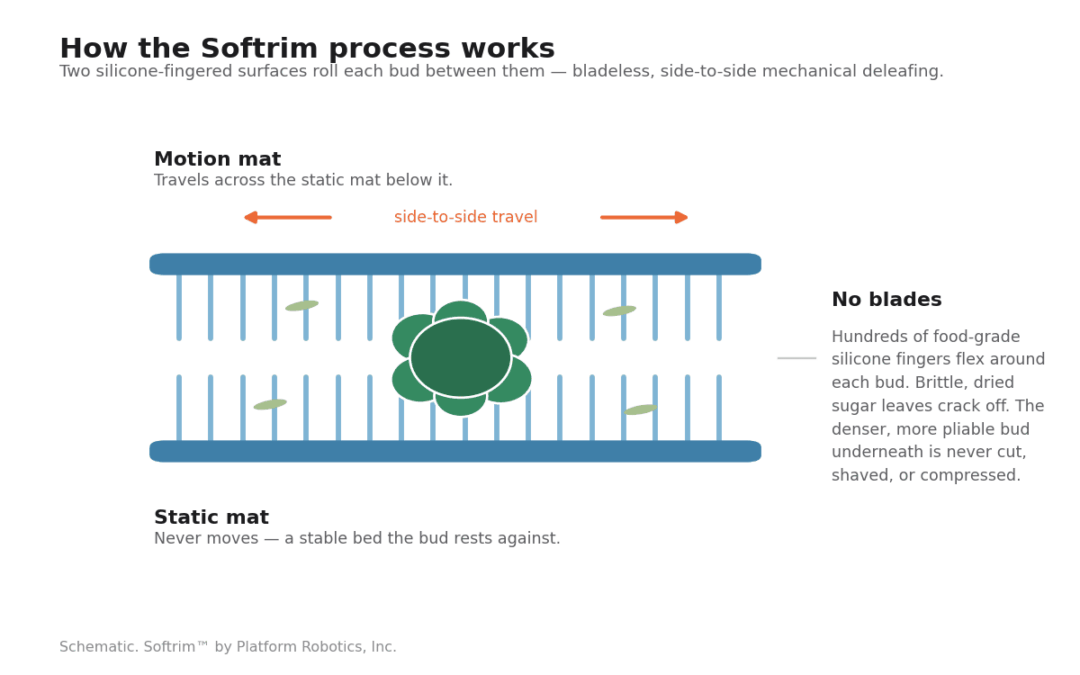
Softrim is a bladeless, mechanical deleafing process. Two food-grade silicone-fingered surfaces roll dried cannabis buds against each other in a side-to-side motion, cracking brittle sugar leaves off without cutting, shaving, or tumbling the flower itself.
The questions below explain the process — the mechanism, the science behind it, and the outcomes — rather than any one machine. The same core mechanism runs across the entire Softrim product line, and has processed more than a million pounds of cannabis harvest.
Short answer
- No blades. Hundreds of silicone fingers flex around each bud and snap off brittle dried leaf. Nothing cuts, shaves, or tumbles the flower.
- Quality comes through intact. With no blade contact and no compression, trichome heads, pistils, calyx structure and cultivar-specific bud shape survive the process.
- It needs properly dried flower — roughly 10–14% moisture and 0.55–0.62 water activity. Wet leaves bend instead of breaking.
- Buck first. Softrim processes individual buds and small clusters, not whole branches.
- It isn’t a finishing step. Typically 50–75% of buds come out ready to bag; the rest need a stem or crow’s foot removed by hand, and larf is best run as its own batch.
Quick reference
Every question on this page, grouped by topic. Jump straight to one:
Mechanism
Quality
Structure
Comparison
Compatibility
Readiness
- Does the Softrim process work on wet or fresh-cut bud?
- How do I know if flower is dry enough for the Softrim process?
- Can the Softrim process over-dry flower during trimming?
- Can the process fix or improve poorly dried flower?
- Does leaving fan leaves on during drying affect the process?
- Does the process require flower to be bucked off the stem first?
- Does stem length affect how well the process works?
Scale
Brand
How the Softrim process works
What is the Softrim process?
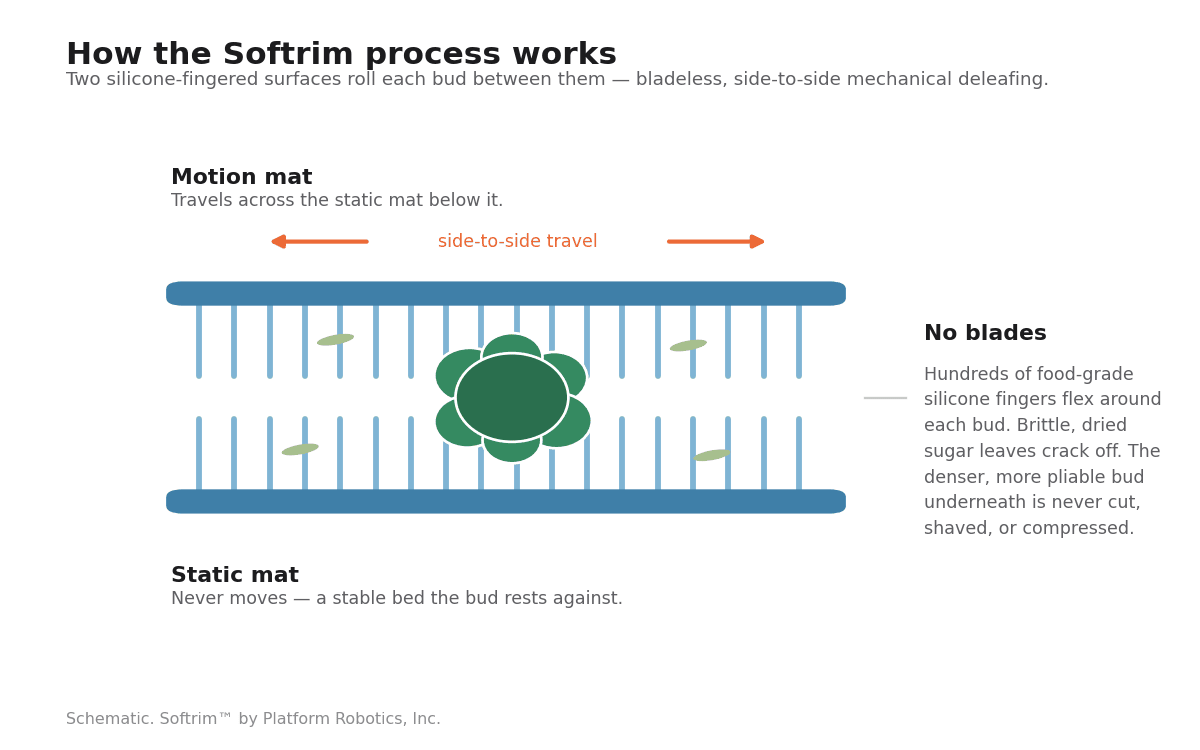
Softrim is a bladeless, mechanical deleafing process that uses two food-grade silicone-fingered surfaces to gently roll cannabis buds against each other in a side-to-side motion. Hundreds of soft silicone fingers work between and around each bud, cracking off brittle, dried sugar leaves without cutting, shaving, or tumbling the flower itself. The same core mechanism runs across the entire Softrim product line, and has processed more than 1 million pounds of cannabis harvest.
How is the Softrim process different from trimming with blades?
Traditional trimmers — bowl trimmers, tumble trimmers, blade-based inline systems — remove leaf material by cutting it away with a blade or grate, which means the flower itself is also exposed to that cutting surface. Softrim never cuts. Because properly dried leaves are brittle while the bud underneath stays denser and more pliable, the silicone fingers exploit that difference: they flex around the bud and snap the brittle leaf material off, rather than shearing it.
Why does the process use silicone fingers instead of a grate or mesh?
Grates and mesh systems, used in bowl- and bucket-style trimmers, rely on friction and gravity to force bud through fixed openings, which shaves and compresses the bud’s surface. Silicone fingers are flexible and conform to each bud’s shape instead of forcing it through an opening — that flexibility is what lets the process remove leaf material without reshaping or compressing the bud underneath it.
What’s the difference between the static mat and the motion mat?
Every Softrim unit has two silicone-fingered mats that play different roles. The static mat never moves — it forms a stable bed the bud rests against. The motion mat travels across it, and that relative motion between a fixed surface and a moving one is what rolls each bud between the two finger-covered surfaces and cracks off brittle leaf material. The motion pattern differs by scale, but the underlying static-mat/motion-mat principle is identical across every Softrim product.
Trichome and terpene preservation
Does the Softrim process damage trichomes?
No — the process is extremely gentle. Because there are no blades and no compression against a hard surface, trichome heads stay intact through the Softrim process at a rate confirmed by side-by-side microscopy comparisons against hand-trim and tumble-trim results. The silicone fingers are soft enough to work around trichomes rather than shearing across them.
Does Softrimming affect terpene content?
Terpenes are stored in the same trichome structures the process is designed to protect, so preserving trichomes largely preserves terpene content as well. Because there’s no blade contact and no compression, growers commonly report stronger aroma at cure compared to tumble-trimmed batches from the same plant.
Why do many growers describe Softrim-processed flower as “hand-trimmed” in appearance?
Conventional trimming systems damage calyx integrity and pistil retention through blade contact and repeated tumbling, which is what gives most machine-trimmed flower its processed look. Because the Softrim process never cuts or tumbles the bud, it preserves natural pistil structure, calyx formation, and bud contour — the same visual markers people associate with careful hand-trimming.
Bud structure and cultivar preservation
Does the Softrim process change the shape of the bud?
No. There’s no compression, tumbling, or shaving involved — each bud rolls gently between two silicone surfaces rather than being forced through a chamber or against a grate. The bud’s natural shape, density, and color come through the process intact.
Can the process preserve cultivar-specific bud structure, like calyx stacking or foxtailing?
Yes. Distinctive cultivar characteristics — calyx size and stacking, foxtailing, pistil expression, overall bud architecture — are exactly what gets flattened out by blade contact and tumbling in conventional systems. Because Softrim relies on neither, it tends to preserve those distinguishing features rather than processing every cultivar into a similar-looking result.
Comparison to other trimming methods
How does the Softrim process compare to bowl or bucket trimmers?
Bowl and bucket trimmers are blade-tumblers: a crank or motor spins internal blades or drags bud across a serrated grate, and leaf material — along with some of the bud’s surface — gets sheared off. Softrim doesn’t cut anything; leaf material is cracked off by flexible silicone fingers instead, which is the core difference behind why the two methods produce visibly different finished flower.
How does the Softrim process compare to hand-trimming with scissors?
Hand-trimming is precise and controllable but slow — a skilled trimmer processes roughly a pound every 3–4 hours. The Softrim process removes the bulk of that same leaf material in a fraction of the time, with the operator (or the machine, at commercial scale) controlling load size and number of passes rather than removing every leaf individually by hand.
Is the finished flower from Softrim as good as hand-trimmed flower?
For most cultivars, Softrim-processed flower is comparable to hand-trim on the visual markers that matter most — bud shape, pistil retention, trichome coverage. For exotic or trophy-tier flower where every bud needs to be perfect, many growers run Softrim as the first pass and hand-touch-up the top tier afterward, capturing the speed of mechanical processing with the finish of hand-trimming where it counts most.
Strain and flower compatibility
Does the Softrim process work on every strain?
The underlying mechanism has been tested across more than 100 strains and works on virtually every dried cultivar — dense indica flower, fluffy sativa colas, autoflower harvests, and outdoor-grown bud all process successfully. A few flower types call for adjusted technique rather than a different process: very small popcorn buds benefit from smaller loads and more passes, and unusually sticky strains benefit from a cleaner pre- and post-trim.
Can the process handle both indica and sativa flower structures?
Yes. Because the process doesn’t rely on blades or cultivar-specific settings, it adapts to a wide range of flower densities and structures — from dense, compact indica-leaning buds to longer, more open sativa-leaning colas — without needing to be reconfigured between them.
Does the process work on cultivars with heavy sugar leaf production?
Yes, and cultivars with a higher leaf-to-flower ratio are often exactly where mechanical leaf removal saves the most time relative to hand-trimming. The flexible silicone fingers reach into the internodal spaces where sugar leaves emerge between calyxes, as long as those leaves are dry enough to pass the Finger Test. Heavier-leafed cultivars typically need a longer dry and more passes through the mechanism than lighter cultivars.
Can multiple cultivars be processed through the same run?
Yes, though if cross-contamination between cultivars is a concern, cleaning the silicone surfaces between cultivar runs is recommended.
Drying and preparation requirements
Does the Softrim process work on wet or fresh-cut bud?
No — the process is built around properly dried flower with brittle leaves, generally in the 10–14% moisture / 0.55–0.62 water activity range. Wet leaves are too pliable for the silicone fingers to crack off cleanly; they bend instead of breaking. Flower needs to be dry before it goes through Softrim, not the other way around. Our dry room field notes cover the day-by-day targets.
How do I know if flower is dry enough for the Softrim process?
The Finger Test is the simplest field check: run a finger down the side of a bud, and if the small leaves snap off clean instead of bending, it’s ready. For more precision, a water activity meter reading of 0.55–0.62 aw is the target range the process is built around. There’s more on judging readiness without lab equipment in our drying guide.
Can the Softrim process over-dry flower during trimming?
No. Processing takes minutes per load and doesn’t introduce heat, airflow, or compression that would change moisture content — flower comes out at essentially the same moisture level it went in at. Cure timing is unaffected by the trimming step itself.
Can the process fix or improve poorly dried flower?
No. The process is built to preserve the quality of properly prepared flower — it can’t reverse problems caused by uneven or improper drying. Moisture content, bucking quality, and overall preparation still have the biggest impact on the finished result; Softrim protects what’s already there rather than correcting what isn’t.
Does leaving fan leaves on during drying affect the process?
Indirectly, yes — fan leaves left on during drying add extra moisture that has to be removed, which typically extends overall dry time before flower is ready for Softrim. Removing fan leaves before drying tends to produce faster, more even drying and gets flower to trim-ready condition sooner, though both approaches can work given enough dry time.
Does the process require flower to be bucked off the stem first?
Yes. Softrim is designed to process individual buds and small flower clusters, not whole branches — flower should be hand- or scissor-bucked from the stalk before processing. Bucking cleanly, with no stem left on the flower, produces the most consistent results and the least manual cleanup afterward.
Does stem length affect how well the process works?
Generally no — because the process doesn’t rely on blades or cutting surfaces, stem length doesn’t interfere with leaf removal the way it can with conventional trimmers. That said, the process is designed for bucked buds and small clusters rather than whole branches, and any stem left on a bud will still be attached — not removed — after processing.
One process, every scale
Is the Softrim process the same across all Softrim products?
Yes — the underlying mechanism (silicone-fingered surfaces, static belt and motion belt, no blades) is identical across the product lines. The trichome and bud-structure outcomes stay consistent across the whole line because the mechanism doing the work is the same.
How much flower can the process handle at commercial scale?
The commercial Softrim line has processed more than 1 million pounds of cannabis harvest across cultivators including Standard Wellness, Berry Green, Common Citizen, and Sunmed Growers, at throughput suited to continuous production-line operation rather than batch-by-batch home processing.
About Softrim and Platform Robotics
Who makes the Softrim process, and where?
Softrim™ is developed and manufactured by Platform Robotics, Inc., a robotics company based in Michigan. The commercial-scale Softrim 1000 and 2000 have been trusted by cultivators including Standard Wellness, Berry Green, Common Citizen, and Sunmed Growers across more than 1 million pounds of processed harvest.
How did the Softrim process come about?
The mechanism was developed out of a 2020 cannabis cultivation project, where engineers observed hand-trimmers spending 3–4 hours per pound of flower. After testing blade-based approaches and finding they consistently damaged bud structure, the breakthrough came from a simple observation: properly dried sugar leaves are brittle while the bud underneath stays denser and more pliable — meaning leaves can be cracked off rather than cut. That insight became the silicone-finger system used across every Softrim product since.
Is Softrim™ the same company as Softrim Corporation?
No. Softrim™ by Platform Robotics is a cannabis post-harvest equipment maker based in Michigan. Softrim Corporation (softrim.com) is an unrelated technology services company serving senior-living communities. The two share a name but have no connection — “Softrim™ by Platform Robotics” or “the Softrim process” are the clearest ways to reference this technology specifically.
What the process doesn’t do
Transparent limitations belong here on purpose — candor about what a process doesn’t do is worth more to a skeptical buyer than another claim about what it does.
Does the Softrim process produce a fully finished, ready-to-bag bud every time?
Mostly, but not entirely — typically 50–75% of processed buds are ready to bag directly, while the remainder may still have a stem or a “crow’s foot” (a small residual leaf cluster at the base of the bud) that needs manual removal. The process removes the bulk leaf material; it doesn’t replace a final visual check.
Does the process work well on larf?
Not as well as on primary cola flower. Larf — the small, leafy popcorn buds that form on the lower canopy — tends to retain more moisture than denser buds, which means it doesn’t dry as evenly or reach brittle-leaf readiness on the same timeline. Processing larf alongside primary flower can produce inconsistent results; many operations dry and process larf as its own batch, a day or two behind the main harvest.
What are the main limitations of the Softrim process?
Three come up most often: inconsistent drying across a batch produces inconsistent results, since the process depends on uniformly brittle leaves; larf and popcorn clusters generally need to be processed separately from primary cola for the same reason; and any remaining stems or crow’s feet need manual removal afterward, since the bladeless mechanism doesn’t cut or trim stem material.
About this FAQ
These answers describe the Softrim process itself — the mechanism, the science, and the outcomes — and apply across the whole product line rather than any single machine. Pricing, warranty, and model-specific specifications live on the individual product pages.